
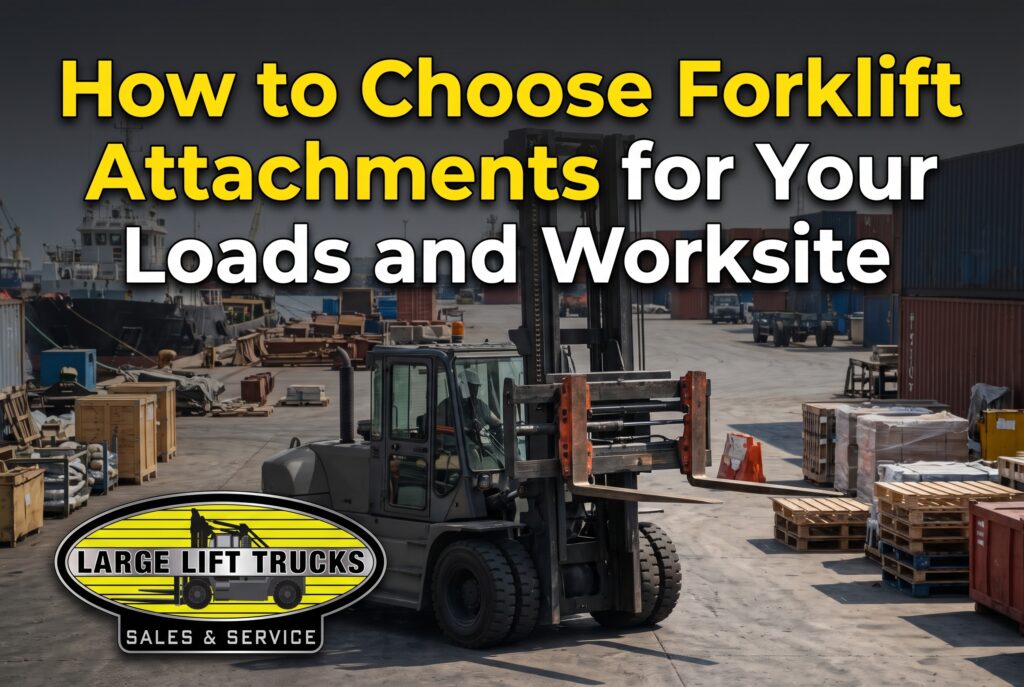
How to Choose Forklift Attachments for Your Loads and Worksite

A well-chosen attachment can help one truck handle several kinds of work. But an attachment isn’t just an accessory: it adds weight, changes the load center and can reduce a forklift’s rated capacity, sometimes significantly.
For Houston operations managers comparing attachments for heavy-duty forklifts, the best starting point is the load and worksite, not the attachment catalog. Consider what you handle, how often you move it, where the truck operates and what the exact truck-and-attachment combination is approved to lift.
Start with the load and the truck
Before selecting an attachment, record:
- The load’s weight, dimensions and center of gravity
- How the load must be supported, gripped, rotated or positioned
- The truck’s make, model, serial number, carriage class and data-plate rating
- Required lift height, working aisle width and surface conditions
- Available hydraulic functions, flow and pressure
An attachment must fit the truck mechanically and work within its hydraulic limits. A mismatch can cause poor performance, damage components or create an unsafe setup. This matters for any operation, from a warehouse choosing a side shifter to a port evaluating container handlers and spreader frames.
Common forklift attachments and where they’re used

Fork extensions and side shifters
Fork extensions provide a longer support surface for long loads, such as bundled lumber, pipe or oversized pallets at construction sites and industrial yards. They don’t increase lifting capacity. Because they can move the load’s center of gravity farther forward, you must verify the truck’s approved capacity for the specific setup. Extensions should be correctly sized, secured and used with the load supported toward the fork back, not picked up on the tips.
A side shifter moves the forks and load a short distance from side to side without repositioning the entire truck. It can help warehouse and distribution-center operators align pallets in tight spaces. It also adds weight and may affect capacity, so the truck’s rating must account for the attachment.
Rotators, clamps and drum handlers
A rotator turns a load, often to empty a bin or reposition material. It may be used in manufacturing, recycling and industrial processing. Load retention and a suitable operating area are important: a load must remain controlled throughout rotation.
Clamps grip loads that can’t be handled safely with ordinary forks:
- Bale clamps handle compressed materials such as cotton, textiles, paper and recycling bales.
- Carton clamps grip certain boxed goods without pallets, commonly in distribution or appliance handling.
- Paper roll clamps support rolls of paper in printing, converting and paper-handling facilities.
- Drum handlers grip and move drums in manufacturing, chemical and industrial operations. Choose a design made for the drum size, weight and handling method.
The clamp’s contact surface and grip force should suit the load. Too little control may let a load shift; too much pressure can damage it.
Jibs, work platforms and hydraulic augers
A fixed jib adds a hook or lifting point for suspended loads. A telescopic jib extends to provide additional reach. These are used for selected maintenance, construction and industrial-yard lifts. Since a suspended load can swing and the jib projects the load forward, verify the capacity at the actual reach and load position.
Work platforms are intended to elevate personnel, but they require particular care. OSHA treats a platform as an attachment that can affect capacity or safe operation. Use only an appropriate, securely attached platform approved for the truck-and-attachment combination, and follow applicable rules, manufacturer instructions and fall-protection requirements. Never use a pallet or improvised basket to lift a person. See OSHA’s guidance on powered industrial truck attachments and work platforms used as attachments.
A hydraulic auger drills into soil and is more commonly associated with compatible telehandlers or other purpose-designed carriers than a conventional warehouse forklift. Use one only when the carrier, mounting arrangement and hydraulic system are specifically designed and approved for the application.
Container spreader frames
A spreader frame engages shipping containers at designated lifting points. It’s used with purpose-designed container-handling equipment in ports, terminals and other freight yards. This is not a general-purpose accessory to mount on an ordinary forklift: the handler, spreader and container must be configured and rated for the work.

If your operation serves the Port of Houston or another Texas freight yard, start by matching the equipment to the container type, weight, handling cycle and yard conditions. Explore Large Lift Trucks’ container handler information to learn more about this equipment category.
Understand capacity de-rating before you lift
An attachment can reduce capacity in two ways: it adds weight to the front of the truck, and it can move the payload’s center of gravity farther forward. This changes the combined center of gravity and reduces the truck’s remaining capacity. The effect can be dramatic with heavy attachments, long extensions, jibs or loads carried at an extended reach.
A simplified moment calculation can help explain the issue. For example, if a truck is rated for 5,000 pounds at a 24-inch load center, shifting the load center to 30 inches gives a rough estimate of 4,000 pounds: 5,000 × 24 ÷ 30. That is an illustration, not an approved operating capacity. It does not fully account for the attachment’s weight, lift height, load position, stability or the truck’s configuration. Do not use this calculation to set a working limit.
Instead, have the truck manufacturer, or another appropriately qualified professional where applicable, determine the approved residual capacity for the exact truck, attachment and operating configuration. OSHA requires written manufacturer approval for modifications or additions that affect capacity or safe operation, and the truck’s capacity information must be updated as required. Check the OSHA powered industrial truck standard. The truck’s data plate is the key reference: if it’s missing, unclear or doesn’t reflect the attachment, stop and get the setup reviewed before use.
Planning a new attachment or truck-and-attachment package? Large Lift Trucks can help you review the application and explore new and used forklift inventory or new forklift options. For Houston forklift sales, rentals or service guidance, contact the team.
Match hydraulics, fitment and site conditions
Hydraulic attachments need compatible auxiliary circuits. Confirm the attachment’s required flow and operating-pressure range against the truck’s specifications. Have a qualified technician check the valve, hoses, couplers and any flow or pressure controls. Too much flow can make an attachment operate too quickly or create heat; incorrect pressure can strain the attachment or truck components. Don’t assume two similar attachments share the same hydraulic requirements.
Fitment also depends on the truck’s make and model, carriage class, attachment weight and mounting method. Before ordering, have the attachment supplier or qualified dealer verify the fit using the truck and attachment identification details, not just the brand name.
Houston and Texas conditions deserve attention, too. Gulf Coast humidity and rain can accelerate corrosion, particularly on exposed steel, pins, welds, hoses and electrical connections. Inspect and maintain attachments regularly, and address corrosion or damage before it affects structural integrity.
Buying new or used attachments
A new attachment may be a sensible choice when you need a specific configuration, documented specifications or a warranty. A used attachment can reduce upfront cost, but only if its condition and compatibility can be verified.
Before buying used, inspect:
- The model and serial-number plate, rated capacity and attachment weight
- Carriage hooks, locks, pins and other mounting points for wear or damage
- Welds, frames, arms and contact surfaces for cracks, deformation or repairs
- Hydraulic cylinders, hoses and couplers for leaks, damage and smooth operation
- Rotator, clamp or telescoping functions under a controlled inspection
- The attachment’s manuals and approval information for the intended truck
A professional inspection can help identify issues that aren’t obvious from a photo or brief demonstration. Large Lift Trucks provides parts support and forklift service and repairs in Houston. If the need is temporary or tied to a project, ask about forklift rental. For equipment purchases, financing options may also be available, subject to approval.
FAQs about forklift attachments
Do forklift attachments reduce rated capacity?
Often, yes. An attachment adds weight and may move the load center forward. Use the capacity approved for the exact truck-and-attachment setup, not just the truck’s original rating.
Can any attachment fit any forklift?
No. Confirm carriage class, mounting details, truck model, attachment weight and hydraulic requirements before purchase or use.
Can a forklift attachment lift people?
Only with an appropriate platform and a truck-and-platform setup that meets applicable approval and safety requirements. Never lift people on forks, pallets or improvised platforms.
Choosing the right attachment can improve flexibility without compromising safety: provided it fits the truck, the task and the approved capacity. For help evaluating an attachment, finding compatible parts or planning a rental or purchase, request a quote from Large Lift Trucks.