
7 Mistakes You’re Making with Used Forklifts for Sale (and How to Fix Them)

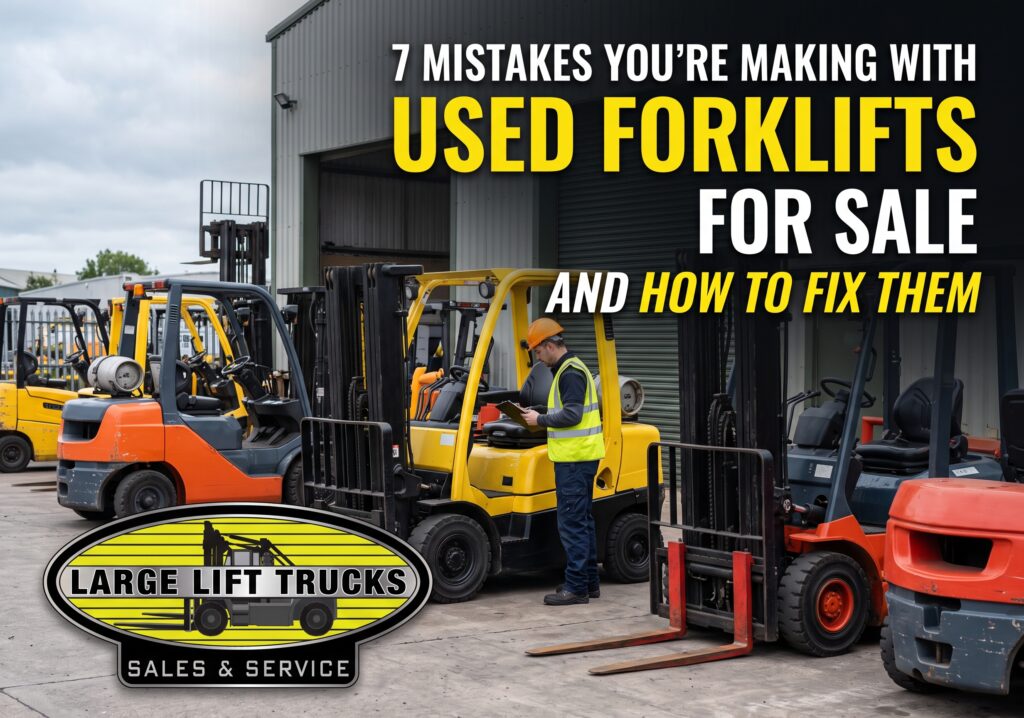
Buying a used forklift in Houston, Texas, is often one of the smartest financial moves a business can make. When you find the right piece of heavy-duty equipment, you can save anywhere from 30% to 50% compared to buying new. However, the used equipment market can be a bit of a minefield if you aren't careful. A "good deal" on paper can quickly turn into a massive headache if the truck spent its life in a corrosive coastal environment or if it simply isn't the right fit for your facility's layout.
At Large Lift Trucks, Inc., we have spent over 40 years helping businesses across Texas navigate the complexities of material handling. We have seen it all, from the perfectly maintained Taylor forklift that runs for decades to the "bargain" unit that breaks down three days after delivery. To help you avoid the common pitfalls, we have compiled the seven most frequent mistakes buyers make and, more importantly, how you can fix them before signing on the dotted line.
1. Fixating on the Sticker Price instead of Total Cost of Ownership
It is easy to get tunnel vision when you see a low price tag. However, the purchase price is only the tip of the iceberg. If a used forklift for sale is priced significantly lower than the market average, there is usually a reason.
If you buy a cheap unit that immediately needs a mast rebuild, a new set of tires, or hydraulic valve repairs, your "savings" vanish instantly. You must factor in the total cost of ownership (TCO), which includes:
- Immediate repair needs: What does it need to be job-site ready?
- Maintenance intervals: Does this model require specialized, expensive service?
- Downtime costs: If this machine breaks down, how much will your operation lose per hour?
The Fix: Always request a detailed quote that includes any refurbishments already performed. At Large Lift Trucks, our pricing is often 30-40% below typical dealer prices because we focus on value and longevity, not just the lowest possible number. You can even explore flexible financing options to spread out the cost of a higher-quality, more reliable machine.
2. Choosing Equipment That Doesn’t Match Your Application
One of the most frustrating mistakes is purchasing a massive, high-capacity forklift only to realize it cannot fit through your warehouse doors or turn in your narrowest aisles. Alternatively, some buyers underestimate their load requirements and end up with a truck that is constantly operating at its maximum capacity, which leads to premature wear and safety risks.
In Houston’s diverse industrial landscape, from the tight warehouses near the Ship Channel to the sprawling outdoor yards in Pasadena, matching the truck to the environment is critical.
The Fix: Before you start shopping, measure everything. Know your:
- Maximum load weight and load center.
- Maximum lift height (don’t forget to check your ceiling and sprinkler clearances).
- Minimum aisle width for a 90-degree stack.
- Surface type: Do you need cushion tires for smooth concrete or pneumatic tires for gravel yards?
If you are unsure which category you need, check out our guide on the different types of forklifts to see which fits your Texas facility best.
3. Ignoring the History of the Machine
In Texas, the environment plays a massive role in a forklift's condition. A used forklift that spent five years in a climate-controlled warehouse is a very different machine than one that worked in a chemical plant or near the saltwater air of the Gulf Coast.
Houston’s high humidity and heat can wreak havoc on electrical systems and cause accelerated corrosion if the equipment wasn't properly maintained.
The Fix: Ask for the "pedigree" of the machine. Where did it work? What was it moving? A reputable seller should be able to tell you if the truck was a single-shift unit or a 24/7 workhorse. It is best that you prioritize machines with clear maintenance logs. If the seller can't provide a history, you are essentially gambling with your budget.
4. Overlooking Battery Health on Electric Units
If you are looking at used electric forklifts, the battery is the most expensive component. A new industrial battery can cost several thousand dollars. Many buyers simply check to see if the truck "turns on" and moves, but they fail to test the battery's ability to hold a charge under a full load.

The Fix: Ask for a battery discharge test. This will tell you exactly how much life is left in the "fuel tank." You should also inspect the battery for signs of neglect, such as heavy sulfation (white powder) or dry cells. If the battery is near the end of its life, use that information to negotiate the price or ask the dealer to include a refurbished battery.
5. Skipping a Professional, Hands-on Inspection
You wouldn't buy a used car without popping the hood, and you certainly shouldn't buy a used forklift without a thorough inspection. A quick "test drive" around the parking lot is not enough to reveal hidden issues in the transmission, hydraulic pump, or mast chains.

The Fix: If you aren't a mechanic, bring one with you. A professional inspection should include:
- The Mast: Check for cracks, excessive wear on the channels, and chain tension.
- Hydraulics: Look for leaks at the cylinders and control valves.
- Forks: Ensure they aren't bent or worn beyond the 10% safety limit.
- Engine/Motor: Listen for unusual noises and check for fluid leaks.
At Large Lift Trucks, our highly skilled mechanics perform comprehensive forklift repairs and inspections on every piece of equipment we sell, ensuring you can sleep in peace knowing your equipment is job-ready.
6. Disregarding Parts and Service Availability
It is a common trap: you find an obscure, "off-brand" forklift at a rock-bottom price. However, when a specific hydraulic seal or a control module fails, you realize that parts have to be shipped from overseas with a six-week lead time.
In the fast-paced Houston logistics market, six weeks of downtime is unacceptable.
The Fix: Stick to major brands with established support networks in Texas, such as Hyster, Taylor, Caterpillar, or Toyota. Before you buy, ensure you have a local partner who stocks OEM and aftermarket parts. Buying a brand that is well-supported locally ensures that you can get back to work quickly when the inevitable happens.
7. Buying in a Rush Without a Plan
Often, businesses wait until their current forklift dies completely before they start looking for a replacement. This desperation leads to "panic buying", choosing the only machine available that day rather than the machine that is right for the long term.
The Fix: Start your search before you have an emergency. If your current truck is showing signs of age, start browsing inventories now. If you do find yourself in a bind, it is often better to rent a forklift for a month to give yourself the time to find the perfect used unit to purchase. This allows you to maintain operations without making a high-stakes, rushed decision.
Conclusion: Finding Reliability in the Houston Used Market
Buying used doesn't have to be a gamble. By focusing on the total cost of ownership, verifying the machine's history, and ensuring you have local parts support, you can secure a high-performing lift truck that serves your business for years. Now, isn't that a win-win situation?
If you are ready to upgrade your fleet or need honest guidance on your next purchase, our team is here to help. We combine 40+ years of experience with a locally owned, service-first approach that ensures you get the right equipment at a competitive price.
Ready to take the next step?
- Browse our inventory: Visit our homepage to see our current stock of used forklifts.
- Get a quote: Contact our Houston office today for a straightforward, no-pressure consultation.
- Check your trade-in: See how much your current equipment is worth toward a newer model.
Frequently Asked Questions
How many hours is "too many" for a used forklift?
There is no single answer, as it depends on how the truck was maintained. An internal combustion forklift can often run for 10,000 to 15,000 hours if serviced correctly. However, a truck with 5,000 hours that was never maintained can be in worse shape than one with 12,000 hours and a full service log.
Do you offer warranties on used forklifts in Houston?
Yes, most reputable dealers, including Large Lift Trucks, offer various levels of warranties or "guaranteed functional" periods to ensure you are satisfied with your purchase.
Can I ship parts if I buy a used forklift from you but operate outside of Texas?
Absolutely. While our service and sales headquarters are in Houston, we ship parts globally to ensure our customers can keep their equipment running regardless of their location.