
Rebuild or Replace? The 2026 Cost Math for an Aging Forklift in Houston

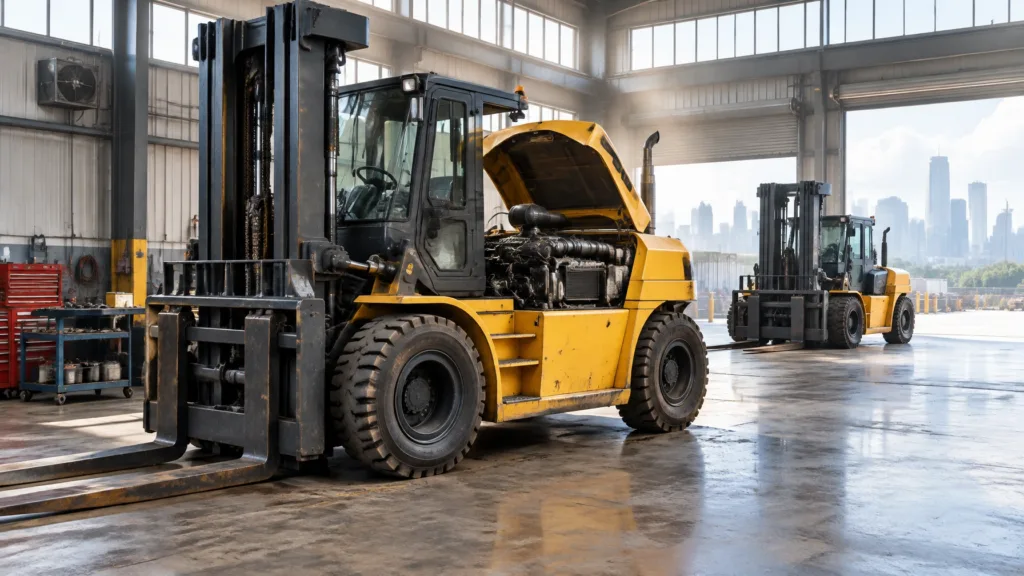
When a high-hour forklift starts needing frequent repairs, the question is not simply, “How much will this fix cost?” It is whether repairing the truck will give your operation enough safe, reliable service to justify the money, and how that compares with replacing it.
For Houston-area operations, the answer depends on the truck’s condition, workload, parts support, downtime costs and the price of a suitable replacement. This is especially true for large forklift trucks: a major repair may look expensive until it is compared with replacing a high-capacity machine.
What does a major rebuild include?
A major rebuild should start with a condition assessment, not a parts list based on guesswork. Depending on the truck’s design and inspection results, the work may include:
- Engine and cooling system: overhaul or replacement of worn engine components, plus checks of the radiator, water pump, hoses and belts.
- Transmission and powertrain: transmission, torque converter, differential, drive axle and final-drive work as required.
- Hydraulic system: pump, control valve, cylinders, hoses, seals and fluid condition.
- Mast and carriage: inspection of rails, rollers, chains, carriage, forks and tilt cylinders.
- Brakes, steering, wheels and tires: wear and function checks, followed by repairs or replacement where needed.
- Electrical system: wiring, connectors, starter, alternator, battery or controller, safety interlocks and instruments.
- Frame and corrosion: inspection of load-bearing areas, welds and mounts, particularly where moisture or salt exposure may have caused damage.
A rebuild does not necessarily mean replacing every component. A useful quote explains what will be repaired, what will be replaced, what will be reused and what may trigger additional work.

2026 cost math: compare the scope, not just the invoice
Forklift repair prices vary by make, model, capacity, parts availability, labor and what an inspection uncovers. The figures below are broad screening examples from a published 2026 cost guide, not Houston quotes or guaranteed prices. They describe individual repair categories, not the cost of a complete rebuild, and should not be added together as a package estimate. A high-capacity truck may cost substantially more to repair.
| Repair item | Published screening range | What to confirm in a quote |
|---|---|---|
| Engine overhaul | $3,000–$8,000 | Whether machine-specific parts, cooling work and labor are included |
| Transmission rebuild | $2,000–$5,000 | The exact transmission scope, testing and warranty |
| Hydraulic pump | $1,000–$3,500 | Whether contamination, valves or related components also need work |
| Lift-cylinder rebuild | $500–$1,200 | Cylinder size, rod condition, seals and removal/reinstallation |
| Brake work | $300–$1,000 | Which components are included and whether both sides require service |
| Tires | $150–$400 each | Tire type, size, capacity and installation |
Use these figures only to frame questions. Ask for a written, truck-specific estimate and note any exclusions. For more context, see this 2026 forklift repair cost guide.
Replacement costs also depend on what the job requires. A comparable used truck may be a practical option; a new unit may bring different capabilities, warranty coverage and financing considerations. Compare like with like: rated capacity, load center, lift height, mast, attachments, tires, fuel type and delivery. Browse used forklifts for sale and new Hoist forklifts, but confirm current availability and pricing directly.
Three options to put side by side
| Option | Best fit when… | Main cost and operational questions |
|---|---|---|
| Repair as needed | The truck is generally sound and issues are isolated. | Will another likely repair arrive soon? How much unplanned downtime can the operation absorb? |
| Major rebuild | The frame and core structure are sound, parts are available, and the work can restore dependable service. | What exactly is included? How long should the truck serve after the work? What warranty applies? |
| Replace with used or new | The truck is unsafe, poorly supported, mismatched to the job or accumulating major system failures. | What is the delivered cost of a suitable truck? How quickly can it be available, and what will financing or leasing cost? |
A break-even framework
Compare the expected cost of each option over the same planning period, often 24 to 36 months. Include more than the repair invoice or purchase price.
Rebuild cost over the period
Quoted rebuild + likely follow-up repairs + scheduled maintenance + downtime or backup-equipment cost − expected residual value.
Replacement cost over the period
Purchase or lease cost + delivery and setup + financing costs + maintenance and operating-cost differences − trade-in value − expected residual value.
Then consider productive hours, not only dollars. A repair that costs less on paper may be a poor choice if the truck sits for weeks waiting for parts during a busy season. Conversely, replacing a specialized high-capacity truck may be unnecessary if a defined rebuild can safely return it to service for several more years.
A repair-to-replacement percentage can be a useful first screen, but it is not a universal rule. Use the truck’s actual value and a realistic replacement quote; do not treat a generic percentage as a final decision.
Need a second opinion before approving a major repair? Large Lift Trucks’ Houston service team handles preventive maintenance, emergency repairs, hydraulic and control valve repairs, mast work and engine, steering and hydraulic rebuilds. Its mechanics average more than 25 years of heavy-equipment experience, and the team services trucks up to 100,000 pounds. Discuss an inspection or repair scope.

What tips the decision?
Before choosing, evaluate these factors together:
- Current market value: A rebuild may be easier to justify when a suitable replacement costs far more than restoring the existing truck.
- Hours and duty cycle: Meter hours matter, but so does the work. Heavy loads, frequent starts, ramps and long shifts can wear components faster than lighter use.
- Parts availability: Check whether parts for the make and model are available at a reasonable cost and lead time. Parts support may include OEM, aftermarket, used or rebuilt options, depending on the part.
- Downtime cost per day: Estimate lost throughput, overtime, delayed shipments and any rental or backup-truck expense.
- Required service life: A rebuild intended to bridge one season is different from one expected to support several years of planned operation.
- Application changes: If your loads, lift heights, surfaces or shift patterns have changed, the current truck may no longer be the right fit even after repairs.
Houston and Texas operating conditions
Houston heat can put extra demand on cooling systems and hydraulic components, while humidity and rain can contribute to moisture-related wear and electrical corrosion. Salt exposure varies: an inland warehouse is not the same as a port, coastal or marine environment. If the truck works around salt air or salt-contaminated moisture, have its frame, mast, connectors, wiring, fasteners and cylinder rods checked carefully.
These conditions do not automatically mean a truck should be replaced. They do make a thorough inspection especially useful. Include cooling performance, hydraulic leaks and contamination, connector condition and corrosion on structural areas in the assessment. For local service and support, see forklift repair in Houston.
When is it better to walk away?
A rebuild may be the wrong investment if inspection finds serious damage to load-bearing structures, multiple major systems needing work at once, safety-critical parts that cannot be sourced, or recurring failures with no clear root cause. It may also make little sense if the repair scope approaches the cost of a suitable replacement and the older truck still carries substantial downtime risk.
Safety comes first. OSHA says powered industrial trucks should be examined before being placed in service, and unsafe trucks must be removed from service until repaired. See OSHA’s pre-operation guidance. A rebuild should never be used to justify continued operation of a truck with unresolved safety defects.

Decision checklist
Before authorizing a rebuild or replacement, make sure you can answer these questions:
- Has a qualified technician inspected the truck and identified the cause of each major issue?
- Is the frame, mast and other load-bearing structure in acceptable condition?
- Does the estimate list parts, labor, testing, exclusions and warranty terms?
- Are critical parts available, and what is the expected lead time?
- What will downtime cost, and is a rental or backup truck needed?
- How long must the truck remain in service?
- Does it still match the loads, lift height and work environment?
- Have you compared the rebuild with a like-for-like used or new replacement?
Frequently asked questions
Is a high-hour forklift automatically due for replacement?
No. Hours help describe use, but they do not determine condition by themselves. Maintenance history, duty cycle, structural condition, parts availability and repair trends all matter.
Should a business repair a forklift one issue at a time?
Repair-as-needed can make sense when the truck is fundamentally sound and problems are isolated. If major failures are recurring, ask a technician to assess the whole truck so you can compare the likely total cost with a rebuild or replacement.
What information should I provide for a repair assessment?
Share the make, model, year, serial number, hour-meter reading, known repair history, symptoms and how the truck is used. Clear information helps the service team assess the scope and identify relevant parts.
For a Houston-area assessment, request forklift service and include the truck’s make, model, year and the issues you are seeing. If replacement is the better fit, review available inventory or ask about financing options. A side-by-side estimate can help you make the decision with fewer surprises.