
Forklift Parts Guide for Houston Operations

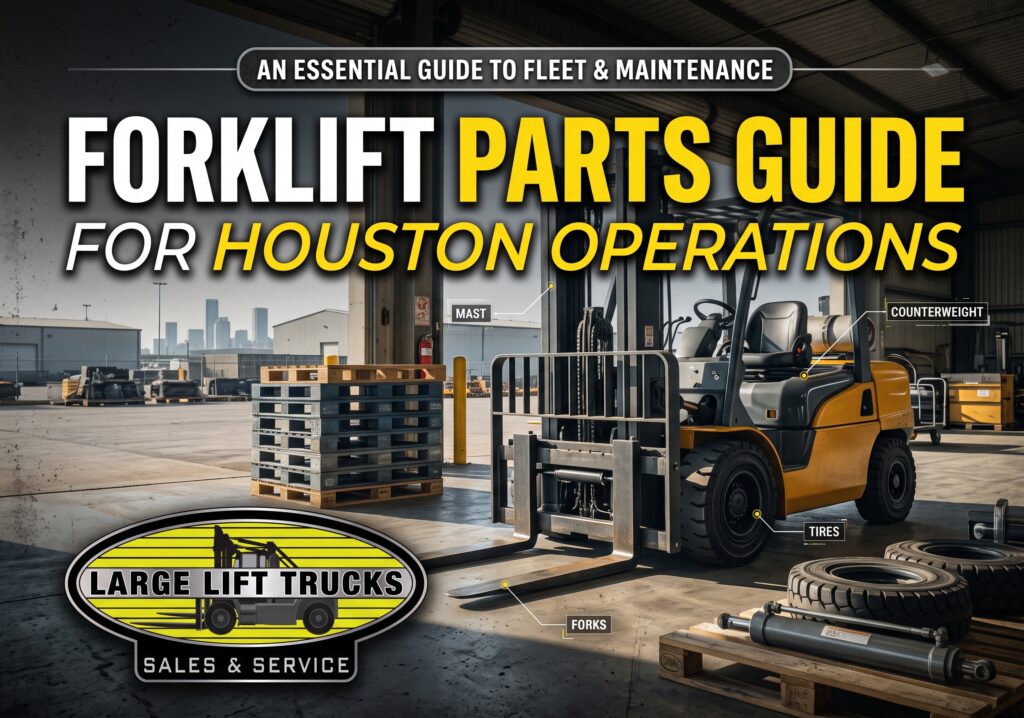
The right replacement part can help your forklift return to work safely and keep a small repair from turning into a longer interruption. The wrong one can mean delays, repeat labor, or a new problem caused by a poor fit. For Houston and Texas businesses, choosing a forklift part starts with identifying the exact truck and understanding the trade-offs among OEM, aftermarket, and rebuilt options.
Large Lift Trucks supplies forklift parts for Hyster, Caterpillar, Toyota, Hoist, Taylor, Yale, Nissan, Clark, and other major brands. The parts department offers OEM, aftermarket, and rebuilt options, with parts shipped to customers in the U.S. and globally. If you’re comparing options, here’s what to check before ordering.
Request forklift parts or contact Large Lift Trucks to discuss your requirements.
OEM, aftermarket, and rebuilt parts: What’s the difference?
The best option depends on the part, the forklift’s age and condition, your budget, and how quickly you need it. Price matters, but so do fitment, availability, warranty terms, and the cost of downtime if the replacement fails.
| Part type | What it generally means | When it may make sense |
|---|---|---|
| OEM | A new part made by or for the forklift’s original manufacturer. | Newer trucks, warranty-sensitive repairs, and applications where exact specifications are especially important. |
| Aftermarket | A new replacement made by a supplier other than the original manufacturer. | Older or out-of-warranty trucks, especially when the supplier confirms compatibility and the part meets the required specifications. |
| Rebuilt | A used component that has been repaired or restored for reuse. The work and testing can vary by supplier and part. | Major components such as pumps, cylinders, and valves, when a suitable core can be inspected and rebuilt with clear testing and warranty terms. |
OEM parts are often the most straightforward choice for matching manufacturer specifications, but they may cost more or take longer to source. Aftermarket options can offer a lower purchase price, but “compatible” should be confirmed for the precise model and configuration. Rebuilt parts can make financial sense for expensive assemblies, provided the supplier explains what was replaced, what was tested, and what warranty applies.
“Rebuilt” and “remanufactured” are not always used consistently across suppliers. Ask what work was done rather than relying on the label. For any option, check whether warranty coverage includes parts only or also labor, and whether installation, contamination, or other exclusions apply.
Match the part to the exact forklift
A forklift’s make and model are a starting point, not always enough to confirm fit. Trucks can differ by serial-number range, mast, capacity, attachment, engine or battery system, and previous modifications.
Before requesting a quote, gather:
- Manufacturer, exact model, and serial number from the data plate.
- Approximate year, operating hours, and truck capacity.
- Mast type, lift height, and attachment details, where relevant.
- The part number from the old component, if available.
- Clear photos of the part, its label, connectors, mounting points, and surrounding assembly.
- Measurements or specifications that may affect fit, such as tire size or cylinder dimensions.
For an electrical or hydraulic component, include connector type, port arrangement, or other identifying marks. For a replacement fork, confirm the carriage class and dimensions. If the old part number is missing or unreadable, a parts supplier can use the truck details and photos to help identify a match.

Common forklift parts and what to verify
The same type of part can come in several configurations. Ask the supplier to confirm fitment against your truck’s model and serial number before placing an order.
- Hydraulic pumps: Compare pump type, displacement, pressure rating, rotation, shaft, mounting, and ports. A failing pump can be a symptom of contamination or another hydraulic problem, so replacing it without checking the cause may lead to repeat failure.
- Cylinders: For lift or tilt cylinders, confirm bore, rod diameter, stroke, closed length, pin dimensions, and port location. If considering a rebuilt cylinder, ask what was repaired and whether the unit was pressure-tested.
- Control valves: Verify the valve configuration, functions, ports, controls, and pressure settings. A similar-looking valve is not necessarily the right valve for safe, correct operation.
- Masts and chains: Mast components vary by design and lift height. Check chain specifications and length, mast configuration, and the relevant roller or carriage details. If a mast or chain appears damaged, have it assessed by a qualified technician.
- Brakes: Confirm the truck’s brake design and axle configuration, along with the matching friction components and hardware. Brake repairs should be checked and tested before the truck returns to service.
- Tires: Match tire type and size, load rating, tread, compound, and wheel details. Houston facilities may have a mix of indoor concrete, outdoor pavement, loading docks, and debris, so describe where and how the forklift operates.
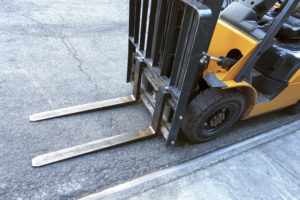
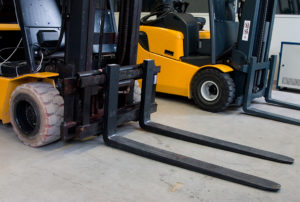
- Forks: Confirm carriage class, length, width, thickness, hook spacing, and locking arrangement. Forks are load-bearing components: do not return damaged forks to service based on appearance alone.

Fork condition deserves particular attention. OSHA advises removing unsafe forks from service; its powered industrial truck guidance on forks describes conditions to inspect, including cracks, wear, straightness, and fork-lock function. Follow the truck manufacturer’s instructions and applicable safety requirements.
Questions to ask before ordering
A clear quote helps prevent surprises after the part arrives. Before you buy, ask:
- Can you confirm this part fits my exact model and serial number?
- Is it OEM, aftermarket, or rebuilt, and what manufacturer or supplier made it?
- What is included? Confirm whether seals, mounting hardware, connectors, or related components are included.
- What is the warranty? Ask about duration, parts versus labor, exclusions, and what happens if the part fails.
- Is there a core charge or return deadline? This can apply to rebuilt components.
- What is the current availability and estimated shipping time? Confirm the destination, freight cost, and tracking details, especially for international orders.
- Are there installation or testing requirements? Ask whether the supplier has recommendations for installation, fluid cleanliness, calibration, or commissioning.
These questions are useful whether the part is headed to a warehouse in Houston, a Texas manufacturing facility, or an operation farther away.
Plan critical spares around your fleet
A modest spare-parts plan can help reduce avoidable downtime, but stocking every possible component ties up space and budget. Start with your maintenance history, truck count, usage, and typical delivery lead times.
Depending on the fleet, it may be worth reviewing regular-use items such as filters, common seals, hoses, and tires. For critical trucks, consider whether having a frequently needed mast roller, brake component, or other model-specific item on hand would reduce the impact of a breakdown. Keep a record of the exact part numbers and approved alternatives for each truck.
Inspect forklifts regularly and report leaks, damaged forks, unusual mast behavior, worn tires, or changes in braking promptly. Early attention can help a service team identify the problem before it grows. For repair support, explore Large Lift Trucks’ service department, which handles maintenance and repairs including hydraulic pumps, control valves, brakes, tires, and mast work.

Forklift parts and equipment support in Houston
Large Lift Trucks’ parts department supports a wide range of makes and models, with OEM, aftermarket, and rebuilt parts available and shipping offered to U.S. and international customers. To help confirm a match, share the truck’s model and serial number, the old part number if available, and clear photos.
- Request a parts quote.
- Arrange forklift service if you need help diagnosing a failure or installing a component.
- Explore forklift inventory if repair costs or truck condition have you weighing replacement. For forklift sales in Houston, the inventory includes new and used equipment.
- Ask about financing if you’re considering equipment purchases; financing is subject to approval.
If you’re sourcing forklift parts in Houston or elsewhere in Texas, a few details up front can make it easier to compare price, availability, and fitment with confidence.
Frequently asked questions
Can I order a forklift part using only the make and model?
Sometimes, but the serial number and configuration help reduce the chance of a mismatch. Share the data-plate details and photos when possible.
Are aftermarket parts always less expensive than OEM?
Not necessarily. Prices and availability vary by part and supplier. Compare the complete quote (including shipping, warranty, and any return or core terms) rather than the part price alone.
Is a rebuilt part a good choice?
It can be, depending on the component and the quality of the rebuild. Ask what was replaced, how the part was tested, whether the core must be returned, and what warranty applies.
Can Large Lift Trucks ship forklift parts outside Houston?
The company’s parts department ships to customers beyond Houston, including international destinations. Confirm availability, delivery timing, and freight details when you request a quote.