
Container Handlers 101: A Houston Port Operator’s Guide to Choosing the Right One

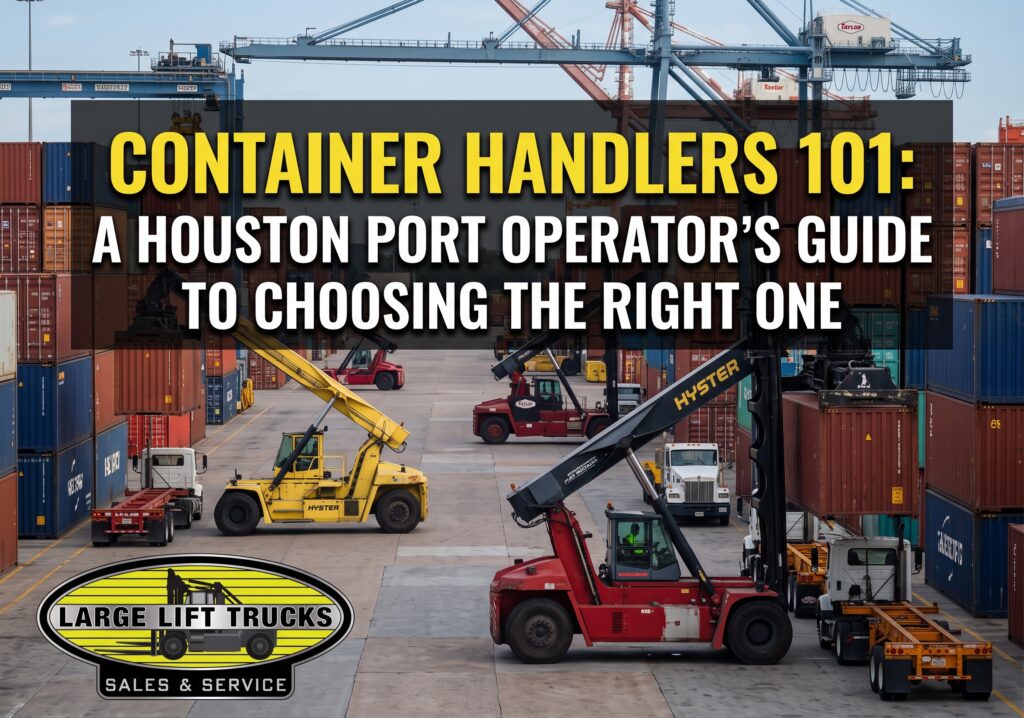
Port and intermodal operations in Houston depend on moving containers safely, efficiently and with equipment suited to the work. The right machine can reduce delays and make better use of yard space. The wrong one may struggle with load weight, stacking height or tight turns.
Port Houston handled a record 4.3 million TEUs in 2025, a 4% increase over 2024. That scale makes equipment selection and maintenance important considerations for container yards across the Houston Ship Channel and Texas.
This guide explains what container handlers do, how they compare with other large equipment, and what to check before you buy, rent or lease.
What is a container handler?
A container handler is heavy equipment designed to lift intermodal shipping containers using a specialized spreader that connects to the container’s corner castings. It may be built to handle empty containers, loaded containers, or a range of containers depending on its configuration.
The term covers several machine types, including dedicated empty and loaded container handlers and reach stackers. They’re different from conventional forklifts: container handlers use a spreader rather than forks and are designed around the size, weight and lifting points of ISO containers.
A terminal tractor, sometimes called a yard truck or spotter, has a different role. It pulls containers on chassis or terminal trailers around a yard, but it does not lift or stack them. If you’re looking for a terminal tractor for sale, it’s worth defining whether your operation needs more lifting capacity, more horizontal transport, or both.
Container handler, reach stacker, large forklift or terminal tractor?
| Equipment | Main job | Lifts containers? | Typical advantage | Main limitation |
|---|---|---|---|---|
| Dedicated loaded container handler | Lift and stack loaded containers, usually from the front row | Yes | Built for heavy container loads | Less flexible for reaching into deeper rows |
| Empty-container handler | Move and stack empty containers | Yes | Efficient high stacking in empty depots | Not designed to lift loaded containers |
| Reach stacker | Lift containers and reach into other rows | Yes | Flexible placement and retrieval | Capacity can fall as reach increases |
| Large conventional forklift | Handle forkable cargo such as machinery, steel or palletized loads | Not with standard forks | Versatile for heavy non-container cargo | Not a container handler unless properly designed and equipped |
| Terminal tractor | Move trailers and chassis within the yard | No | Efficient yard transport | Cannot lift or stack containers |
“Front-lift” is sometimes used to describe a machine that approaches a container from the front. It isn’t a consistent equipment classification, so ask the seller to specify the machine design, spreader type and intended application. Don’t assume a conventional large forklift can safely lift an ISO container simply because its rated capacity sounds high.
Empty versus loaded handling
Start by identifying what the machine will lift most often.
Empty handlers are built for repeated moves and stacking of empty containers. Their rated capacities are much lower than those of loaded handlers, but their design can allow for taller stacks. For example, the manufacturer specifications for some empty-container models describe stacking configurations of up to six, seven or eight containers, depending on container dimensions and model. Those figures are examples, not a guarantee that a particular machine can achieve the same stack height in your yard.
Loaded handlers are built for substantially heavier loads. The key is to check the rated capacity for your actual container weight, size, spreader and lift position, not just the largest capacity printed in a brochure. Capacity can vary between handling a 20-foot and 40-foot container and can decrease as the machine lifts higher or, in the case of a reach stacker, reaches further.
Top-pick, side-pick and spreader configurations
A top-pick uses an overhead spreader to engage the container’s upper corner castings. It is commonly used for loaded containers and on reach stackers. Check that the spreader suits the container lengths and locking system in your operation.
A side-pick handles containers from the side. This configuration is often used on dedicated empty-container handlers and may suit yards where the layout favors side access. It is not automatically interchangeable with a top-pick or suitable for heavy loaded containers.
In each case, confirm the machine and attachment are rated together. Ask whether the stated capacity includes the spreader, and check which 20-foot, 40-foot or other container positions the spreader supports.
Capacity and stacking height: check the load chart
For your shortlist, document:
- Maximum expected gross container weight, including the container and its contents.
- Whether the job involves 20-foot, 40-foot or other container lengths.
- Required number of containers high, with suitable clearance for safe placement.
- Whether the machine will work in the first row or reach across other rows.
- The spreader’s weight and configuration.
Then ask for the manufacturer’s load chart for those exact conditions. A headline rating alone does not confirm the machine can lift your heaviest container at the required height and position. For reach stackers, compare capacity at each row: load limits can change substantially with reach.
If you’re evaluating equipment in Houston, you can browse our container handler equipment and view current inventory. Before you narrow your options, share your heaviest container weight, lengths, stack height and yard layout with our team. We can help you focus on machines that fit the application.
Turning radius and yard layout
A machine’s turning radius is only one part of its working footprint. The spreader, container length, aisle width, trailer positions and nearby stacks all affect how it moves through the yard.
Ask for the manufacturer’s dimensions with the intended attachment and container, not only the machine’s unloaded turning figure. Before committing, map out:
- Aisle widths and turning areas for 20- and 40-foot containers.
- Space for trailers, chassis, traffic flow and safe access.
- The machine’s width, height and clearance around structures.
- Whether the yard surface can support the machine and its loads.
If possible, arrange a demonstration or layout review using your actual operating conditions. A machine that fits on paper still needs enough room to turn, position and safely recover from a misaligned container.
Houston conditions: heat, humidity and salt air
Houston’s heat, humidity and coastal air can add wear to electrical connections, fasteners, hydraulic components and exposed metal. Include local conditions in both the equipment specification and the maintenance plan.
Consider asking about corrosion protection, weather-resistant electrical connections, cooling-system capacity and air-conditioning suitable for your operating hours. Establish regular checks for corrosion, hydraulic leaks, damaged hoses, spreader operation, tire condition and wear in the lifting system.
A maintenance schedule should reflect your actual duty cycle and the manufacturer’s recommendations. Large Lift Trucks provides equipment service and repairs in Houston, along with parts support. Planning service and parts access in advance can help reduce unexpected downtime.
Used or new, and when renting makes sense
A new machine may make sense when your operation needs a specific configuration, expects consistent high utilization or requires the latest available features. A used machine can be a practical alternative when its condition, maintenance history and specifications match the work. Have it inspected by a qualified technician, and compare the cost of any required repairs with the purchase price.

For a seasonal increase, a project, a short-term contract or a temporary replacement, renting may avoid a long-term commitment. Confirm the available machine’s capacity, spreader configuration, delivery timing and rental terms before relying on it for a particular job.
You can ask about Houston-area rentals or review financing options if you’re considering a purchase. The best choice depends on how often the machine will work, how specialized the application is and what support is available.
Used container handler inspection checklist
Before buying a used unit, review these items with a qualified inspector:
- Service and ownership records: Request maintenance history, hours and details of past repairs.
- Capacity and configuration: Verify the load chart, spreader, container lengths and permitted stacking height.
- Structure: Inspect the chassis, mast or boom, welds and other load-bearing areas for damage or repairs.
- Lifting system: Check spreader locks and movement, hydraulic hoses and cylinders, and any chain or boom wear specified for the model.
- Tires and running gear: Look for uneven tire wear, damage, steering problems and braking issues.
- Electrical and controls: Test indicators, sensors, safety features, controls and fault codes.
- Cooling and cab: Inspect the cooling system and confirm the cab’s climate controls operate as expected.
- Demonstration: Where practical, have the seller demonstrate the machine with a suitable load under controlled conditions.
Do not treat a brief visual inspection as a substitute for a professional evaluation or a review of the manufacturer’s specifications.
FAQs
Can a reach stacker handle both empty and loaded containers?
Some models are designed to handle a range of container weights, but capacity varies by load, row and boom position. Check the load chart for your exact application.
Do container handlers lift 20-foot and 40-foot containers?
Many machines can handle both with an appropriate spreader. Confirm the machine’s ratings and spreader positions for each length.
Is a terminal tractor a substitute for a container handler?
No. A terminal tractor moves containers on trailers or chassis; a container handler lifts and stacks them. Some yards need both types of equipment.
What information should you provide when requesting a quote?
Share the heaviest gross container weight, container lengths, desired stack height, working rows, hours of use, yard conditions and any access constraints.
Find the right fit for your Houston operation
Choosing among container handlers, reach stackers, large forklift trucks and terminal tractors starts with the job, not a brochure headline. Match the machine to container weight, stack height, yard layout, duty cycle and service requirements.
For help comparing equipment, rentals or support options, contact Large Lift Trucks to request a quote. Houston-area operations can also explore our container handler category, inventory, service, parts, financing and rental options.
Port Houston’s 2025 container-volume figure is reported in its annual results announcement. Machine capacities and stacking configurations vary by model and operating conditions; confirm details with the manufacturer’s specifications for the exact equipment.