
Forklift Weight Capacity Rules. Don’t Overload Your Machine

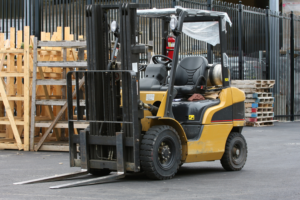
The forklift’s weight capacity is determined by the manufacturer and is indicated on the machine’s nameplate or dataplate. It is recommended not to overload the forklift beyond the mentioned weight. In this blog, let’s discuss why you need to follow the weight capacity and how you can ensure safe forklift operation.
Dangers of overloading the forklift
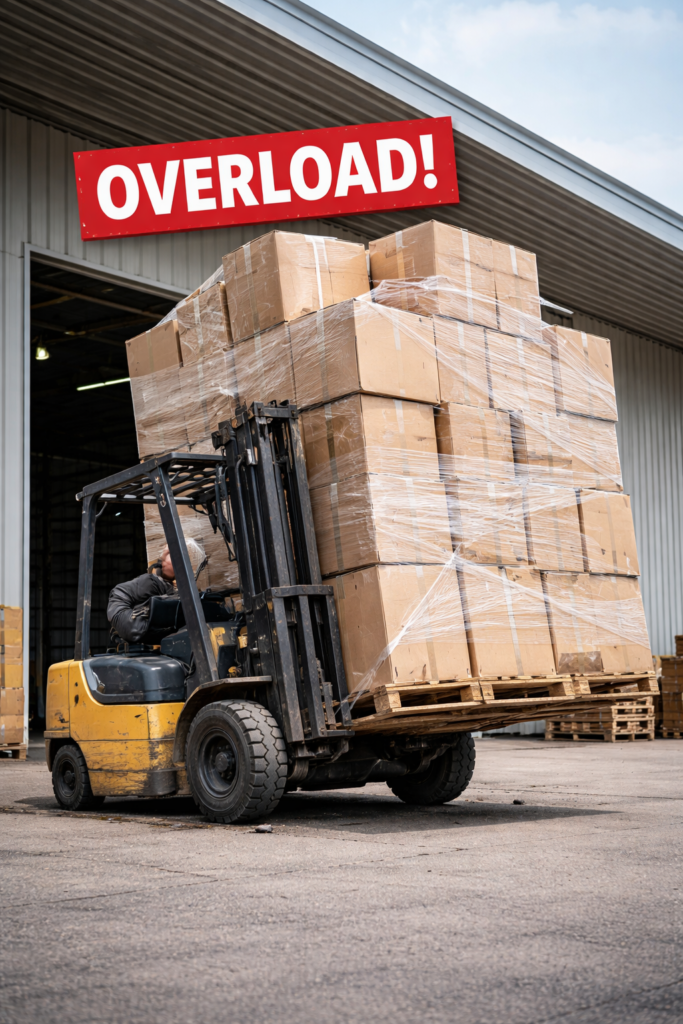
- Overloading will shift the center of gravity in the forklift by increasing the risk of tipping over, and it will also cause injuries and casualties to the operators and others present in the working area.
- If you keep on exceeding the recommended weight, it will strain the forklift’s attachments and components, result in breakdowns, machine wear and tear, and also result in expensive repairs.
- Overloading the forklift will drop your inventory on the ground, which results in damage to your equipment and inventory.
- If you overload the forklift beyond its capacity, you will be imposed fines or penalties for being non-compliant with OSHA regulations.
How to understand the load capacity?
- The maximum weight capacity of the forklift is the weight that you can safely lift when the load is centered. Basically, a 24-inch distance is required from the front of the fork.
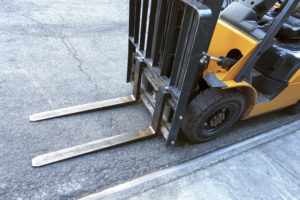
- The horizontal distance between the fork’s front face and the load’s center of gravity is called the load center.
- If you add attachments, it will affect your forklift’s load capacity and load center. It is important to make sure you refer to the load chart and calculate the safe lifting capacity by keeping attachments in mind.

How safely should you operate the forklift?
- Make sure you weigh the load using scales and determine the weight before lifting the load using your forklift.
- Always check the load chart and ensure the load’s dimensions, weight, and center of gravity are under the safe operating limit for your desired lift height and position.
- Make sure you position the load accurately by keeping the heavy load close to the mast and maintaining center position on the forks.
- Reduce the load center distance by loading the large objects width-wise than length-wise.
- Maintain smooth lifting and lowering loads and avoid jerky moves in order to maintain stability.
- Make sure your operators are certified based on OSHA standards and ensure they are following load charts to properly load forklifts and operate safely.
- When your loads are closest to the maximum loads, exercise caution and make sure the loads are rightly positioned, and keep the forks as low as possible during transit.

Points to ponder
Overloading the forklift can be easily avoided by knowing your forklift’s weight capacity and following safe practices.
In order to load the forklift safely, organize the loads squarely, smoothly insert the fork fully and evenly, and slightly tilt the mast to stabilize before you lift the load and transport. Make sure you keep the load as low as possible to the ground level, possibly 4 to 6 inches, and drive the forklift with the mast tilted back.
How to safely operate the forklift?
- Make sure the forklift and forks are in good working condition.
- Know the forklift’s capacity and the weight that you are handling.
- Make sure your work area is free of obstacles and pedestrians.
- Match the forks with the load and insert them into the pallet.
- Keep the loads centered to balance the weight, and if required, strap the loads to avoid falling.
- Lift the loads slowly and steadily by tilting the mast slightly backwards to stabilize the load.
- Keep the loads as low as possible to the ground, preferably 4 to 6 feet above the ground.
- Slightly tilt the mast against the carriage and stabilize it.
- If the load hides your vision, it is recommended to travel in reverse.
- Make sure you drive slowly and carefully during turns and on rough terrain.
- Maintain a safe distance from obstacles, pedestrians, and other vehicles.
- During unloading, make sure you align the forklift in the designated area.
- Slowly tilt the mast forward and release the load, and carefully retract the forks.
To determine the forklift’s weight capacity rules, talk to our experts today.
If you are looking to buy a new or used forklift for your workplace, you’re in the right place. Large lift trucks offer a range of forklifts from all leading brands that meet your specific purpose. We also provide forklifts for short-term or long-term rentals in Houston, Texas. Talk to our expert today and select the right forklift for your industry.
FAQs
What is the forklift’s weight capacity?
The forklift weight capacity is determined by the manufacturer, and it is present on the machine’s name plate or dataplate. It is recommended not to overload the forklift beyond the mentioned weight.
How to understand the load capacity?
The maximum weight capacity of the forklift is the weight that you can safely lift when the load is centered. Basically, a 24-inch distance is required from the front of the fork.
What are the dangers of overloading the forklift?
Overloading will shift the centre of gravity in the forklift by increasing the risk of tipping over; it will also cause injuries and casualties to the operators and others present in the working area.